Here is how we approach it.
Start with the team, not the framework
Before comparing frameworks, look at who will build the app. Native or hybrid, you need engineers with real mobile experience.
A common and costly assumption is that a web developer who knows React can pick up React Native and ship a solid mobile app because the two look alike. Most of the time, that does not hold. Building for the web and building for mobile are different disciplines: different components, different dependencies, different constraints, and a different way of thinking about screens, navigation, and lifecycle. React knowledge helps, but it is not the same skill.
Get the people right first. The framework debate means little without them.
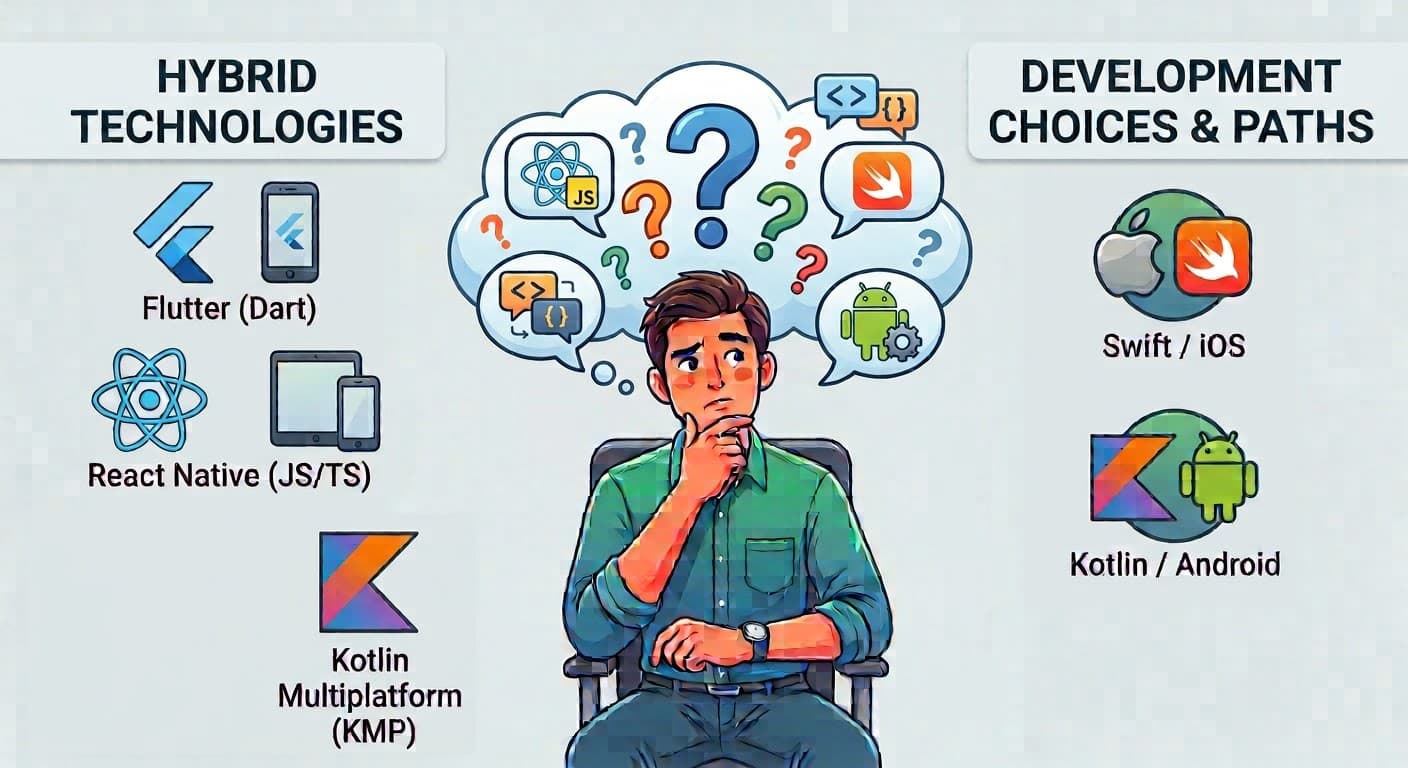
Match the technology to the app, the audience, and the client
Once you have mobile engineers who know what they are doing, the real question is what the app actually needs. Who is it for, and what does the client care about most? If the priority is a native experience, native animations, platform-correct buttons, the specific feel of iOS and the specific feel of Android, then the technology has to respect that.
Some hybrid approaches do. Kotlin Multiplatform, for example, lets you share business logic across platforms while keeping the UI fully native on each one. Part of the codebase is common, part is completely native. You get shared logic where it saves time and native components where the experience demands it.
Going fully native has its own advantages. You can run different architectures per platform, different navigation, and different behavior in the logic layer, not only in the UI. That freedom has real value. The trade-off is resources. Can you build and maintain two separate apps? One app with shared logic and native components? Or one shared app where everything behaves the same across platforms? The answer depends on the app's requirements, the budget, and the team.
Decide once, then stay coherent
After weighing the strengths and weaknesses of each option against the actual project, make a deliberate choice and hold to it. Consistency from the first commit to release is what keeps an app from turning into a patchwork. A clear decision followed loosely is almost as bad as the wrong decision.
The foundation matters more than the framework
No stack saves you from a weak setup. Whatever you choose, the fundamentals stay the same:
- A clean, consistent project structure
- Sound software principles and design patterns
- A solid architecture for communicating with your backend
- Security choices appropriate to each platform and framework
- A codebase kept current as the ecosystem moves
Skip these and the technology you picked will not rescue you. The problems arrive either way.
Where AI earns its place
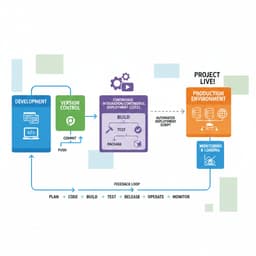
Regardless of the stack, AI has become an indispensable part of building well. It supports engineers rather than replacing them, and it raises the quality floor. At a minimum, we set up agents to review the app for security, performance, and structural issues, to help write and run tests, and to carry the repetitive, error-prone parts of the work. The same applies to automation, CI/CD pipelines, and testing. Using one or more AI tools across these tasks is no longer optional if you want to move fast without cutting corners.
Technical debt keeps score
Ignore any of these pillars and technical debt builds quietly. It stays invisible while things are calm and hits hard the moment you need to change something. That is when the extra bugs appear, the strange behaviors, the failures that trace back to a foundation that was never built properly and a workflow that never had the right tools behind it.
The right stack matters. A strong foundation, a coherent decision, and the discipline to maintain both matter more.
If you are planning a mobile app and want the technology decision made properly the first time, let's talk.