Vibe Coding Gets You Started. Engineering Gets You Live.
AI-assisted development has changed how software gets started. Tools that generate code from natural language prompts, accelerate boilerplate, and help non-engineers bring ideas to life have genuinely lowered the barrier to building. A working prototype that would have taken weeks can now take days.
This is a meaningful shift. For product discovery, investor demos, internal tools, and early validation, the speed is a real advantage.
The challenge begins when that prototype needs to become a product.
The Gap Between "It Works" and "It's Ready"
A prototype built through vibe coding — rapidly, iteratively, often without a defined architecture — carries assumptions that are fine in a development environment and problematic in production.
The code may not be structured for team collaboration or long-term maintenance. Security considerations, input validation, and data handling may have been bypassed in the interest of speed. The infrastructure may not be designed to handle real traffic, concurrent users, or unexpected load spikes. And deployment pipelines, monitoring, alerting, and rollback strategies are rarely part of the initial build.
None of this reflects a failure of the tools or the people using them. It reflects the natural limits of what rapid prototyping is designed to do.
What Production Actually Requires
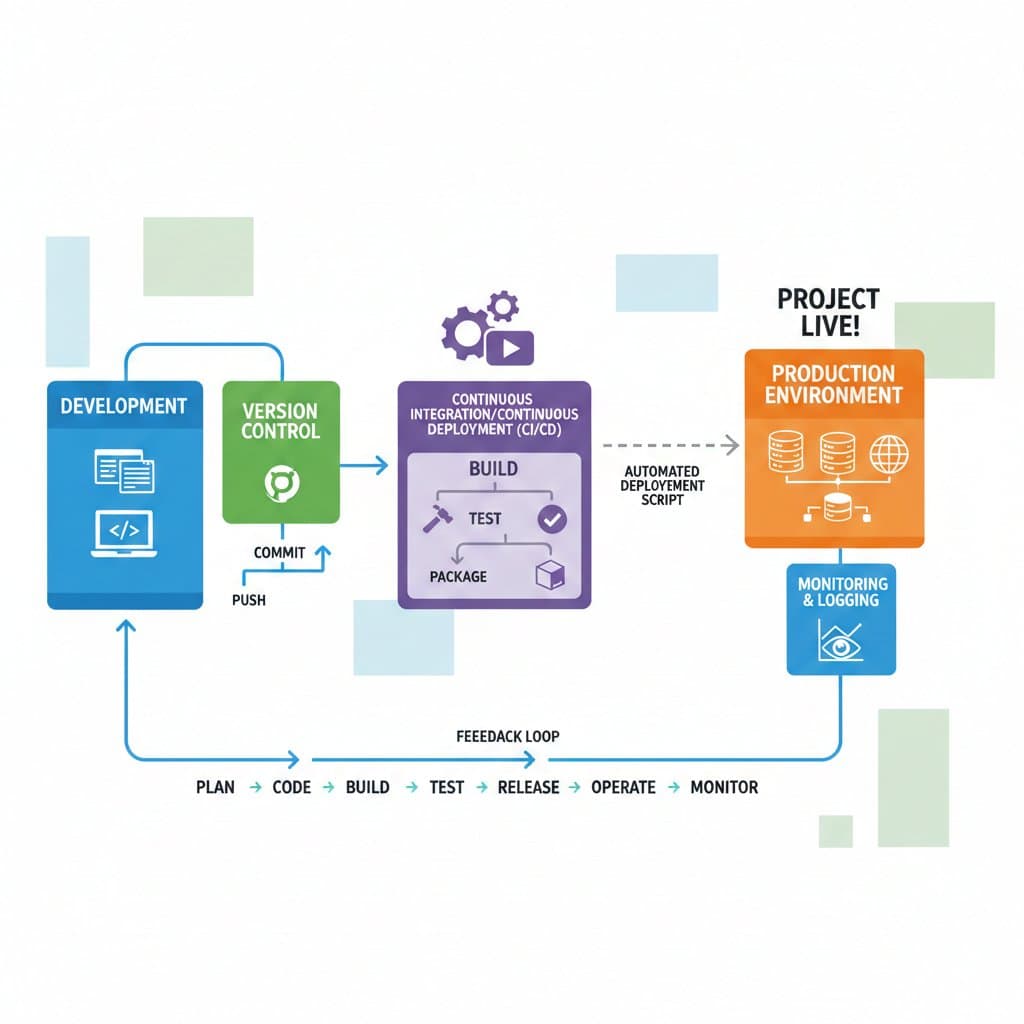
Shipping software that users and businesses can depend on requires a different layer of rigour. The path from development to a live production environment follows a well-defined sequence — one that cannot be shortcut without introducing risk.
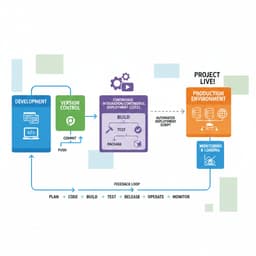
It starts with disciplined version control and commit practices, flows through a CI/CD pipeline that builds, tests, and packages every change automatically, and lands in a production environment via automated deployment scripts. From there, monitoring and logging close the feedback loop — surfacing issues in real time and feeding insights back into the next development cycle.
This is not a linear process you go through once. It is a continuous loop:
Plan → Code → Build → Test → Release → Operate → Monitor — and repeat.
Every step matters. Skipping any of them is where production incidents are born.
Beyond the pipeline itself, production readiness also demands:
- Security architecture and vulnerability assessment
- Performance testing under realistic conditions
- Scalable infrastructure design — cloud-native, containerised, or hybrid
- CI/CD pipelines that enable reliable and repeatable deployments
- Code quality standards that allow a team to maintain and evolve the product over time
- Observability tooling so issues can be detected and resolved quickly
How Ethical Algorithm Can Help
At Ethical Algorithm, we specialise in taking software from concept to production — and in helping teams who have reached the limits of a prototype and need to move forward with confidence.
Whether you need an architecture review, a security assessment, a performance audit, or a full development team to rebuild and scale what you have started, we have the expertise to close the gap between where you are and where your product needs to be.
We work with startups validating their first product, scaleups managing rapid growth, and established businesses modernising their software — always with a focus on reliability, security, and long-term maintainability.
If you are ready to take your prototype to production, get in touch. We can help you get there the right way.